
Cade Hoppe
After exploring the complexities of growing up, letting go, and finding your place in the world, Cade Hoppe returns with Safer at a Distance, an introspective record about navigating uncertainty, confronting uncomfortable truths, and learning to live with the unknown. Blending existential reflections with deeply personal songwriting, the album captures a chapter of life defined less by answers than by the questions that keep us moving forward. I caught up with Cade to talk about creative growth, the pursuit of music, the pressure of chasing success, and finding beauty in the uncertainty of it all.
Safer at a Distance is now available everywhere.
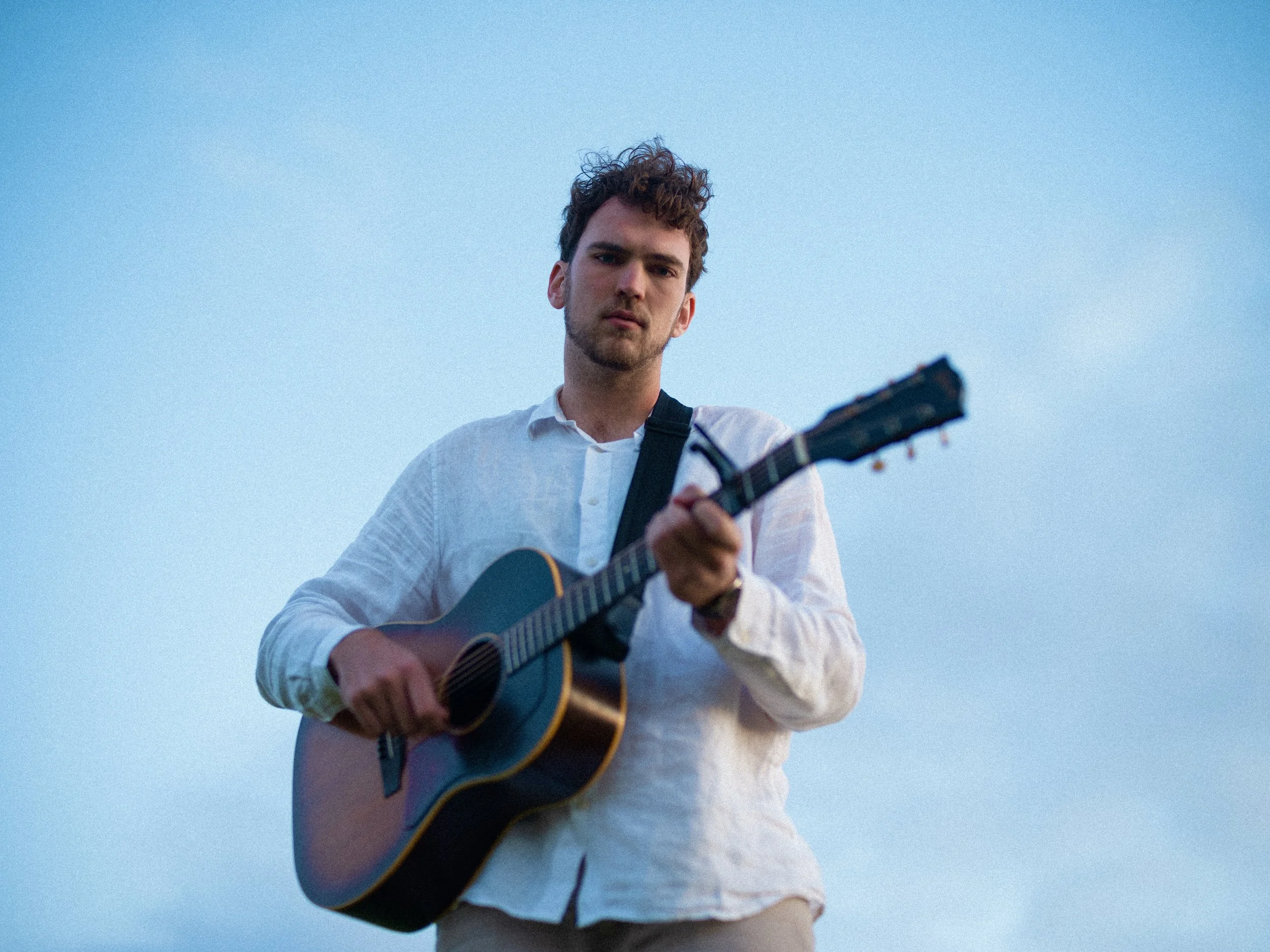
Photo credit: EUDA
Hi Cade, how are you?
Hi Virginie, I'm doing great. How are you? It's been a while—it's great to talk with you again.
Since we last spoke, you’ve continued to evolve as an artist. How would you say your perspective on music and your life has changed since your previous project?
I used to be more of a cynical optimist and now I’m more of an optimistic cynic. In some ways there are only nuanced differences, but you could also make the case that those are diametrically opposed. That’s how I feel: pretty much the same, but also completely different. It’s like the difference between floating in the ocean and seeing a sliver of land out in the distance versus being in the open ocean. I feel like I’m in the open ocean now and I didn’t quite appreciate how much more terrifying it would be. And I’m praying I don’t feel something brush up against my leg.
You describe Safer at a Distance as an existential road trip album that’s neither about the departure nor the arrival. What does that journey represent for you at this point in your life?
It’s just where I am. It’s been a long time now since I first decided to fully pursue music—coming up on seven years—so I feel rather detached from where and who I was back then. In this road trip metaphor, if I still don’t know how far I am from my destination (or where I’m even going) and it took me seven years to get here… then I have to wonder if it would take longer to get back to where I started or to get where I’m going. Will this road trip take longer than 14 years? My song “Still Turn This Around” says it best: “I can feel me drifting, it’s a two tank drive/And I can’t quite fathom there’s an other side.” If I spend too much time thinking about it, it makes me dizzy; I have no choice but to let the world outside the window blur and focus on what's in the car with me because that’s more attainable. I could be going 100 miles an hour but there remains a stillness inside the car.
Acceptance and denial are recurring themes throughout the album. Why were you drawn to exploring the tension between what we know to be true and what we want to believe?
I never set out to write an album about acceptance and denial, these are just the themes that weighed heavily on my mind through the period of writing all these songs. I didn’t really even realize those were the main themes of the album until I had an album. But in retrospect, I think that one of the most interesting things about life is the way that we can complicate even the simplest things—the actual thing is always less interesting than the story we tell ourselves about the thing, and I tend to want to explore that story in my songwriting approach.
On “Halfway Out My Mind,” you explore the loss of innocence and the feeling of falling behind. Have you ever struggled with feeling like you should be further along in life or in your career?
Yes, 100%. Every single day. I think any ambitious person is constantly evaluating their current position and the path in front of them. One of the main things I’m grappling with on this album is the fact that I’m not quite where I want to be, but I also don’t know what the next steps even are. “Halfway Out My Mind” touches on the feeling that if I just definitively lost or failed, it would relieve me of the burden of chasing whatever it is I’m chasing—but I’m not the quitting type so that’s not an option. And no matter what I do, the furthest I could ever push these dreams away is halfway out of my mind, never fully.
The title Safer at a Distance comes from a lyric about a complicated relationship. What does the idea of distance mean to you, both emotionally and creatively?
Well, for one, distance can only exist once you’ve established closeness. You could make the argument that there’s distance between you and anything—until you’ve brought it into your orbit, that is. And then I think it sort of becomes this binary thing where it either is or isn’t in your orbit, and it doesn’t really matter how far from you it’s orbiting. You’re still hurtling through space together. To have distance again would mean letting go of that thing completely. The full lyric is, “We were safer at a distance/You were broken in my arms,” and I think the only complicated part about that is that epiphany paired with the unwillingness to let go.
You went from studying finance and playing college basketball to pursuing music full-time. Looking back, what has taking that leap taught you about trusting yourself when the future is uncertain?
I was a young and stupid 20 year old with a blindly optimistic (borderline delusional) idea of what pursuing music would be like. However, it takes a certain level of delusion to pursue anything in the arts so I have delusion to thank for where I am now. I wouldn’t trade it.
You’ve spent years building your own career while also developing as a producer for other artists. How do you balance creating music for yourself with helping other artists bring their own visions to life?
It really just comes down to scheduling and deadlines, as well as being present in whatever I’m working on at that moment. Truthfully, I don’t give myself as much time to work on my own music as I would like nowadays, but as a full-time producer I do have to take as much work as I can get. I basically just try to book as many projects as I can with other artists and then I do my best to work on my own stuff anywhere in between. The hardest part is staying creatively inspired, but I feel like I’ve gotten into a pretty good groove.
Your album captures a moment in your life without necessarily knowing what comes next. How do you stay motivated during periods when you’re working toward something but can’t yet see the results?
It’s still a mystery to me if I’ll ever see results or know what’s coming next. I’m motivated because I love making music and creating art and I want to get to the end of my life knowing I left things behind that I’m proud of. I’m really just doing it for the love of the game and because I can’t imagine a life without making music all the time.
What has pursuing a career in music taught you about success, and has your definition of success changed since you first started?
Unfortunately, I think the catch-22 with success is that many of the most successful people in the world are probably still unsatisfied—their insatiable hunger is their superpower. Contentment is the enemy of greatness in many ways, so I understand that if “success” is what I’m after, I may be chasing that carrot forever no matter how far I get. But I also love and live by the Jim Carrey quote, “You can fail at what you don't want, so you might as well take a chance on doing what you love.” I fail forward every day.
If Safer at a Distance captures where you are right now rather than where you’re headed, what do you hope your future self will remember about this chapter of your life?
I hope my future self is able to romanticize the hell out of this period of uncertainty. I hope I can use clichés like, “all roads led me here” or “there’s beauty in the struggle.” I want to be the poster child for rewarded determination; the success story that convinces millions of people like me that it could happen to them; and yes, I want the glory of telling retrospectively hilarious stories about painful times in my life on The Tonight Show. I want all the things. Otherwise this never-ending tunnel will make the next chapters feel a whole lot like the last few. For now it’s worth pressing forward.
Connect with Cade: